
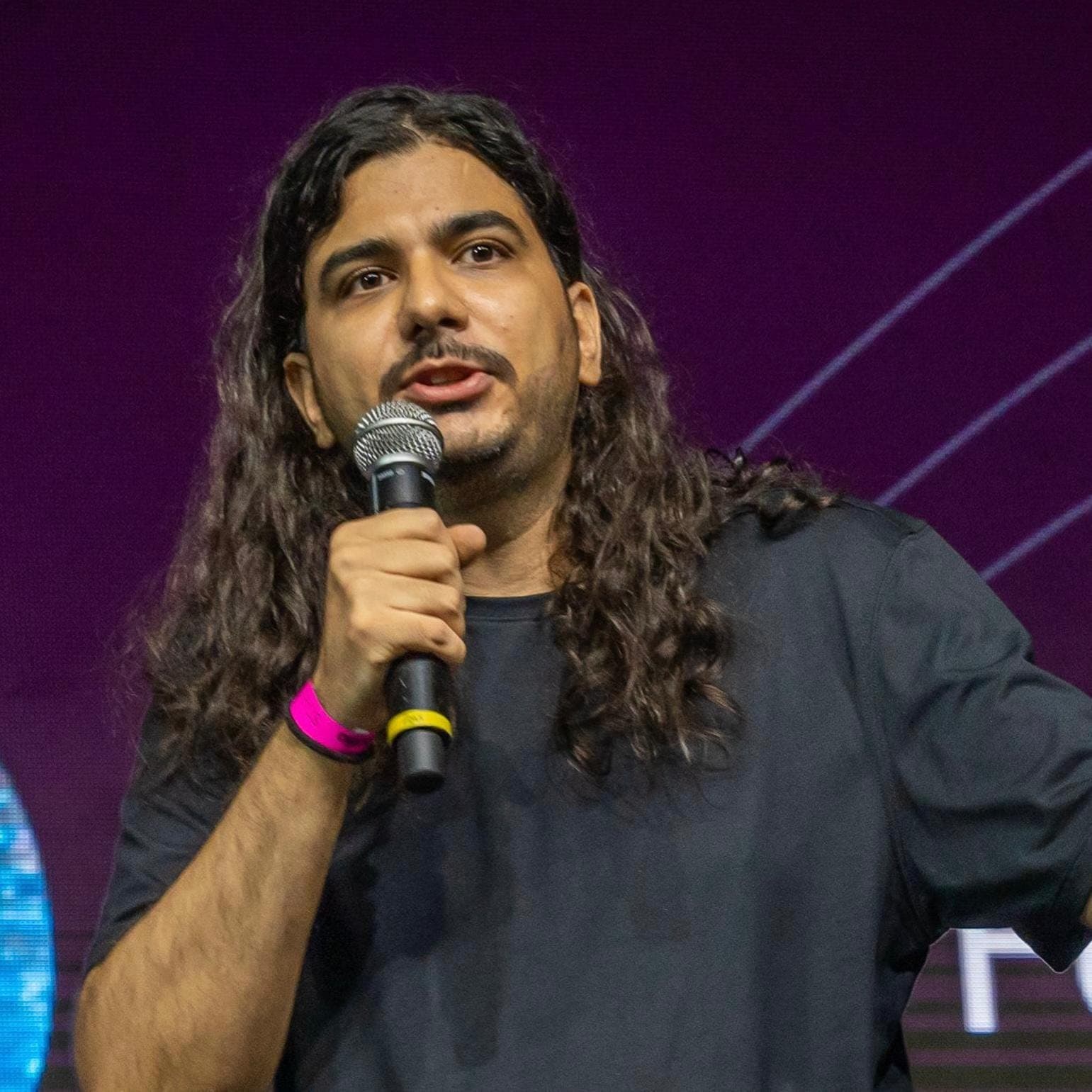


In October, Vinteum participated in two gatherings that brought these perspectives together in different ways. Vinteum's Executive Director Lucas Ferreira joined Bitcoin Dialogues in New York, where open-source Bitcoin developers and researchers met with representatives of financial institutions and companies building and operating Bitcoin infrastructure. Edil Medeiros, Erick Cestari, and Davidson Souza represented Vinteum at Bitcoin Research Week in Amsterdam, alongside protocol engineers, software maintainers, cryptographers, academic researchers, and PhD students.
The gatherings approached many of the same problems from different perspectives. In New York, conversations often returned to the practical requirements of organizations responsible for securing and operating Bitcoin systems, where decisions about cryptography and protocol design have immediate operational consequences. Amsterdam offered more room to explore alternative cryptographic constructions and research ideas whose practical applications may still be years away.
Neither perspective is sufficient on its own. Researchers need to account for the constraints of real-world implementations, while the industry's immediate needs should not be the only guide to Bitcoin's long-term technical development. Bringing these communities together helps expose problems that might otherwise go unnoticed and gives researchers and engineers a better understanding of what their counterparts actually need.
Post-quantum security and AI received much of our attention, alongside mining decentralization, network monitoring, privacy, maintenance of critical software, and new protocol designs. What follows is a selective account of what we heard, the impressions we brought home, and how they connect to Vinteum's work. It should not be read as a statement of consensus among participants. Many conversations ended without settling on a solution, but gave us new problems to investigate and people to collaborate with.
Post-quantum security has to work outside the papers
Post-quantum security received considerable attention at both gatherings. While nobody knows when quantum computers capable of breaking Bitcoin's elliptic-curve signatures will become available, we felt a clear recognition of the need to prepare. The conversations quickly moved beyond choosing a replacement signature scheme to the broader consequences of deploying one. Hash-based signatures are an attractive starting point because they rely on well-understood cryptographic assumptions already present in Bitcoin’s consensus layer. The initial trade-off is signature size: the current SHRINCS proposal produces 5,777-byte stateless signatures, compared with just 64 bytes for BIP340 Schnorr signatures. SHRINCS offers a much smaller stateful signing path, but at the cost of introducing a new responsibility for signers.
With ECDSA or Schnorr, a cryptographic library can manage nonce generation internally. Applications can simply say, “here's a message, please sign it,” and safely reuse the same key without keeping track of previous signatures. Stateful hash-based signatures change that relationship: they rely on one-time signing keys that must never be reused. The library can manage those keys, but it must remember which ones have already been used, even after crashes, backup restorations, or across devices sharing the same key material. Suddenly, something that used to be contained within the cryptographic library requires durable storage and coordination across the entire custody system. SHRINCS offers the larger stateless fallback when that signing history can no longer be trusted.
One discussion in New York described this as a possible conservative trap: by choosing cryptography with conservative security assumptions, we might end up with something much harder to use securely. For a tech-savvy sovereign Bitcoin user, managing signing state may be an annoyance. But consider a Lightning node producing thousands of signatures, or an exchange relying on redundant signing devices and multiparty authorization procedures. Keeping that state consistent could require substantial changes to how these systems operate. The safest choice on paper may not be the safest choice in practice.
Replacing elliptic-curve signatures means losing much more than a signing algorithm. A considerable part of Bitcoin's programmability comes from the algebraic structure of elliptic curves. Key aggregation, threshold signatures, adaptor signatures, blind signatures, and public key derivation are all built on top of it. Hash-based signatures may solve the immediate problem of authorizing transactions in a post-quantum world, but they do not offer the same building blocks.
One research challenge we raised was how to make post-quantum cryptography accessible to the working hacker. Elliptic-curve mathematics is complicated, but developers can reason about it through a remarkably simple interface: points and scalars, a few operations on them, and the difficulty of recovering a scalar from its corresponding point. With these black boxes, we can construct surprisingly sophisticated protocols without mastering all the underlying mathematics. We proposed looking for something comparable in post-quantum cryptography: identifying a small collection of mathematical primitives, understanding how they can be safely composed, and exploring what new protocols could be built from them. We don't necessarily need the same operations as elliptic curves, but we should aim for something more useful to protocol designers than a black box exposing only `sign(message)`.
This is one reason why exploring alternatives to hash-based signatures remains interesting. In New York, we got the impression that lattice-based constructions were generally viewed as a more pragmatic direction for a future phase of Bitcoin's post-quantum transition, although recovering the functionality we enjoy with elliptic curves remains a substantial research challenge. In Amsterdam, conversations placed greater emphasis on isogenies, a mathematical construction based on mappings between elliptic curves. Isogeny-based schemes offer compact signatures, but their security foundations are less mature and their implementations considerably more complex. We believe there is mathematical structure worth leveraging, although we still don't know how to turn it into the kind of programmability developers have with Schnorr. Finding useful constructions and making them accessible to Bitcoin engineers is a research problem of its own.
The choice of a signature scheme is only one piece of a post-quantum upgrade. Bitcoin must also introduce output types through which users can adopt it. Some proposals eliminate elliptic-curve spending paths entirely, while others preserve them alongside a post-quantum alternative. Keeping both could make migration cheaper and more convenient, but a coin remains vulnerable if a quantum attacker can still spend it through the elliptic-curve path..
This led to discussions about mechanisms to eventually disable vulnerable spending paths. One possibility is a tripwire, a consensus mechanism triggered by evidence that elliptic-curve cryptography has been broken. But what constitutes sufficient evidence? A quantum attacker may prefer to conceal its capabilities, and disabling a spending path could leave funds inaccessible to users who had not prepared an alternative. These rules would need to be understood before anyone committed funds to the new output types.
Existing coins present an even harder problem. A new post-quantum output type lets users migrate voluntarily, but some coins will never move. Should Bitcoin continue accepting their elliptic-curve signatures, potentially allowing quantum attackers to steal them? Or should those coins eventually be frozen? Neither choice is a merely cryptographic decision.
Several proposals explored recovery schemes that would allow legitimate owners to spend vulnerable coins using evidence of ownership other than an elliptic-curve signature. Proposals included commit-reveal mechanisms and zero-knowledge proofs involving secrets that a quantum attacker might not know. Their usefulness depends on information that users and wallets have retained, and some coins may offer no practical alternative proof of ownership. Recovery schemes could also weaken incentives to migrate if users expect to be rescued later.
Eventually, these proposals need to become Bitcoin consensus rules. Previous major soft forks, such as SegWit and Taproot, largely improved Bitcoin's existing capabilities. Important as those improvements were, Bitcoin could continue operating without them. A post-quantum upgrade is different. If cryptographically relevant quantum computers become available, Bitcoin will need a way to preserve the security of its users' funds. Unlike previous upgrades, we face an external deadline whose timing nobody knows. This creates tension between Bitcoin's culture of careful technical review and the possibility that time could become scarce. One approach raised at both events was to separate the initial deployment of post-quantum spending capabilities from the more contentious decisions about legacy coins and recovery, allowing migration to begin while research and debate continue.
We came away from both gatherings cautiously optimistic about Bitcoin's ability to prepare for the post-quantum era. Our impression was that there was rough consensus on at least one thing: doing nothing is the worst option. There is plenty of design space to explore around which cryptography to adopt, how to design the new output types, and especially what to do with coins that never migrate. But we didn't encounter a community willing to ignore the threat, nor one eager to deploy a half-baked solution. Even after suitable cryptography and consensus changes are available, adoption across wallets, custodians, hardware devices, and users will take time. We don't know how much time Bitcoin will have, and that uncertainty makes it important to sustain the research, engineering, and coordination already underway.
AI changes vulnerability discovery and the work that follows
AI-assisted security research was another major subject at both gatherings. Developers are already using LLMs to inspect code, generate tests, and search for vulnerabilities, allowing them to investigate parts of a codebase that might otherwise receive little attention. But AI agents can produce convincing vulnerability reports much faster than maintainers can investigate them. A convincing vulnerability report can still be wrong. Someone must reproduce the reported behavior, preferably with a proof of concept or test harness, and establish its security impact. Making it cheaper to search for bugs does not necessarily make them cheaper to fix.
This tension was particularly evident where the perspectives of security researchers and software maintainers met. Finding more bugs is obviously desirable, but overwhelming maintainers with poorly filtered reports can leave them with less time to address genuine problems. Much of the discussion therefore concerned what happens after an AI agent identifies a potential vulnerability: automated reproduction, deduplication, and minimum standards of evidence could help filter out false positives and establish which findings deserve further investigation.
Responsible disclosure becomes more complicated as well. If automated tools can recognize that an apparently routine code change fixes a security vulnerability, publishing a patch may reveal the underlying problem before users have updated their software. This raises difficult questions about how vulnerabilities should be disclosed, how fixes should be developed, and how to reduce the time between preparing a patch and getting it into users' hands.
These conversations connected naturally with formal methods and the specification of security invariants. Rather than simply asking an AI agent to find suspicious code, we can try to describe what a system is supposed to guarantee and use automated tools to search for violations of those properties. But this only shifts part of the problem: a tool may correctly establish that an implementation satisfies an invariant while the invariant itself fails to capture an important security requirement. Understanding what needs to be proved remains a job for people who understand the system.
There is also the question of using AI safely, without introducing new attack surfaces or exposing ourselves to supply-chain attacks. Coding agents execute commands, inspect untrusted repositories, and interact with external services. Giving them unrestricted access to a development environment creates risks of its own. Developers compared practical safeguards, including isolated worktrees, sandboxed execution, and restrictions on filesystem and network access. What struck us was how much everyone seemed to learn from hearing about each other's setups and workflows. There is no established recipe for using these tools effectively and securely. We are still figuring that out, but it was equally clear that AI had already become part of the security toolbox for many of the developers and researchers in the room.
We also felt a certain pressure to adopt these tools, but not the kind that comes from management demanding higher productivity or faster delivery of new features. Malicious actors have access to the same capabilities, and there is evidence of attackers using AI for vulnerability discovery and exploit development. The recent Coldcard exploit, in which the manufacturer suspected AI-assisted discovery of a vulnerability that led to substantial losses, made that concern particularly tangible. We have good reason to fight back with the same weapons, finding and fixing vulnerabilities before attackers exploit them.
Security testing, fuzzing, and vulnerability research are among Vinteum's strongest areas of contribution. Back on our engineering team, Head of Engineering, Bruno Garcia, leads this work, with Erick Cestari contributing to security and vulnerability research. We intend to use AI to strengthen testing and investigation while maintaining a high standard for findings reported to other developers.
Bitcoin's old problems aren't going away
In New York, we also used Bitcoin Dialogues to share developments across Bitcoin’s open-source ecosystem with people who rely on this infrastructure but may not follow its development closely. Mining decentralization was one example, including ongoing work on Stratum V2 and P2Pool v2. Stratum V2 allows individual miners to construct their own block templates rather than leaving transaction selection entirely to pool operators. P2Pool v2 takes a different approach, enabling miners to pool their resources without relying on a centralized operator to coordinate mining and payouts. Vinteum has supported contributors to both projects.
We also talked about the Bitcoin Network Operations Collective (BNOC), whose work Vinteum supports through its fellowship program, and invited participants to share data that could help developers better understand the network. Observing a peer-to-peer network is different from monitoring infrastructure under a single operator’s control: no observer has a complete view. Mining pools, exchanges, and other operators of Bitcoin infrastructure may have access to data that is difficult to collect elsewhere because of their position in the network. Combining measurements from different parts of the network could reveal behavior that would otherwise remain hidden.
Discussions in Amsterdam offered a concrete example of why this matters. Several sessions examined Bitcoin's address-relay mechanisms, which allow nodes to discover peers and maintain connectivity. But advertised addresses may be unreachable, outdated, or deliberately misleading. We examined how address timestamps and connection-testing policies affect the network's resistance to eclipse attacks where an adversary isolates a node from the honest network. Measurements from different vantage points, together with network simulations, could help establish how these mechanisms behave today and whether proposed changes would improve them before anyone attempts to introduce them into Bitcoin Core.
Review and maintenance were recurring concerns too. We discussed the Great Consensus Cleanup, a proposal to address longstanding weaknesses in Bitcoin's consensus rules. Other discussions returned to Bitcoin Improvement Proposals (BIPs), libsecp256k1, and Bitcoin Core itself. Specifications need critical readers, cryptographic implementations need testing, and proposed changes need reviewers who understand the assumptions behind the existing code.
There is something that makes us nervous about the growing attention devoted to post-quantum cryptography and AI. Both are important development frontiers but they could absorb so much of the community's attention that maintenance and deep review of existing software suffer. Elliptic-curve cryptography is a good example. A post-quantum upgrade will not make it disappear overnight. Existing outputs, wallets, and protocols will continue to depend on it during a long transition. There is little point in preparing for future cryptographic threats while neglecting the cryptography protecting users today. Learning to examine security arguments and recognize subtle implementation mistakes takes time. We have been supporting fellows studying elliptic-curve constructions and reviewing their implementations, particularly libsecp256k1, alongside an internal study group in provable cryptography.
On-chain privacy presented another measurement problem. The accuracy of blockchain-analysis heuristics is difficult to establish without datasets containing known ownership relationships. Such datasets would also help measure how effectively privacy techniques like CoinJoin and Payjoin undermine transaction-tracing heuristics. A subgroup took on constructing these ground-truth datasets as a concrete next step, with the aim of benchmarking open-source blockchain-analysis tools.
We also explored new signing constructions and Layer 2 protocols. Nested signing could allow an Ark server to operate as a federation, distributing signing authority among multiple operators without exposing the federation’s internal signing arrangement to clients. LayerTree explored how multiple users could share a Bitcoin UTXO while preserving their ability to enforce individual claims on-chain, using Merkle-sum trees and proposed covenant functionality.
What we took away
Cryptographers need to understand the constraints of wallets, signing devices, and production custody systems. Engineers operating those systems benefit from participating in protocol discussions before proposals are ready for deployment. Open-source maintainers bring experience with the existing software and can recognize when an attractive idea is likely to create more problems than it solves.
For Vinteum, this connects to a challenge that runs through much of our work: developing people capable of taking responsibility for critical Bitcoin software. New York and Amsterdam reinforced how solving one problem can introduce new trade-offs and unexpected consequences elsewhere in the system. Implementing a change is one thing; knowing whether it is worth making, anticipating its second-order effects, and reviewing it critically require a much deeper understanding of the problems Bitcoin developers are trying to solve.
These conversations helped us think more concretely about where Vinteum can contribute. The post-quantum conversations are informing our plans for academic collaboration with two major Brazilian universities, while the exchanges on AI-assisted security research allowed us to share our experience and compare techniques with other engineers. We made connections with people investigating problems in mining, networking, and cryptography that overlap with our current work. These relationships matter because Vinteum's contribution does not have to begin with an idea of our own. Sometimes the most useful thing we can do is help bring another capable developer into a project that already needs one.